Article
Portable bass traps from laundry bags
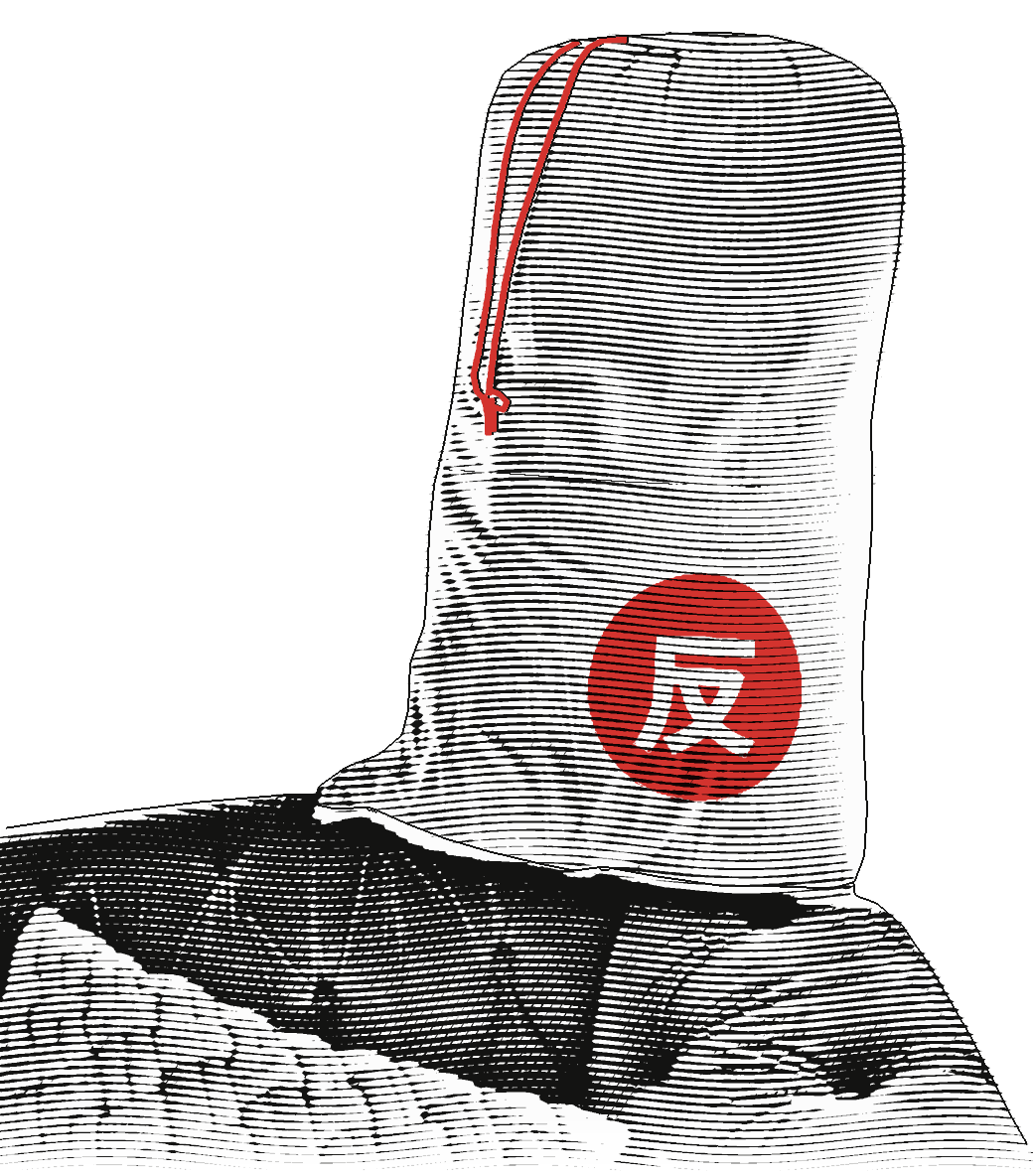
Heavy cotton laundry bags stuffed with Rockwool, finished with a red drawstring and a pie‑plate chop, and wedged into the corners when you want the room to behave. Ridiculous, cheap, and they work.
Like sitting inside a tin can
When I pulled my 1980s Naim Nait amplifier and Linn Kan loudspeakers out of storage and had the Nait restored, the old hum was gone. I set them up in my studio and workspace, put on Daft Punk’s “Doin’ It Right,” and winced. The bass took over the whole room. It sounded like sitting inside a tin can.
My studio measures 11 × 11 × 8 feet—almost a cube. Acousticians treat a square room as a nightmare, and for good reason: when length and width match, both pairs of walls lock onto the exact same bass note at once (1130 ft/s ÷ 22 ft = 51.4 Hz), while the eight‑foot ceiling stacks another mode just above it near 71 Hz. “Doin’ It Right” walks its 808 sub‑bass straight across F♯1 (46.2 Hz) and G♯1 (51.9 Hz)—less than half a hertz away from my room’s twin standing wave—before dropping below 40 Hz. Every time that G♯ landed, both eleven‑foot walls rang together like a struck bell, while notes an octave higher vanished into a hole.
Every audio forum on earth gives the same advice first: treat the room before you touch anything else.
They are right about the physics and wrong about how people live. Commercial bass traps cost hundreds of dollars apiece and ask you to bolt four‑foot slabs of fiberglass across the corners of your home. Even a studio is for people first—for work, friends, windows, and a couch you want to sit on—not a padded cell.
I wanted bass traps that tamed the cube while I worked and disappeared into a closet in ten seconds when I needed the room back.
Why a laundry bag works
Low bass piles up where walls, floor, and ceiling meet. A corner brings three surfaces together at right angles, which makes it the highest‑pressure spot in the room—like the corner behind my couch beside the window. Put a thick bundle of mineral wool into that corner and it turns trapped low‑frequency energy into a tiny amount of heat instead of letting it bounce back at you.
- Air moves through the weave, fibers stay inside. Tight‑woven cotton lets low‑frequency pressure waves reach the Rockwool while keeping itchy stone dust sealed inside the sack.
- Cylinders fit corners. Stuffed round and cinched shut, a jumbo bag stands on its own and leaves a natural triangle of air behind it in the corner, which helps it reach lower notes.
- It comes with a handle. Grab the red drawstring and carry it into the hall closet whenever guests come over.
What you need for four corners
Shipping stuffed bass traps across the country means paying a truck to haul air and stone. Buying the insulation five miles from your house and stuffing four bags outside takes twenty minutes:
- Four 28 × 36 in. cotton laundry bags — these extra‑large 100% cotton drawstring bags are the exact ones I used. Skip nylon or plastic‑lined hampers (they block the air) and skip mesh (it sheds dust). I am also putting together sets of four empty bags with red drawstrings and screenprinted 反 chops in either Anchi red or matte white ink on raw canvas—email me if you want a set.
- One bale of Rockwool Safe’n’Sound — 3 × 15¼ × 47 in. stone mineral wool batts (12 batts per bale—three batts fill one 28 × 36 in. bag, so one bale stuffs all four corners; stocked at The Home Depot and Lowe’s in the US).
- Basic gear for twenty minutes on the patio — a serrated insulation knife (slices compressed stone wool like bread without tearing fibers loose; standard utility blades bind), wraparound safety glasses, nitrile‑dipped work gloves, long sleeves, and a dust mask. Pack each bag firm from bottom to crown, knot the cord tight, tuck it in, and the mess is finished.
- Optional DIY chop stencil & red paint — if a three‑foot sack of stone wool is going to sit on the back of your couch, it helps if visitors can see it is there on purpose. You can download my printable 7.6‑inch chop stencil (PDF) and mist it with Rust‑Oleum Satin Apple Red, which matches Anchi red well. Fair warning: cutting out the small knocked‑out triangle in the middle of 反 takes a craft blade and a little patience—half the reason I’m having a screenprinter run sets of four.
What changed when I measured (and listened)
I measured the 11 × 11 × 8 studio with Room EQ Wizard and a calibrated UMIK‑1 microphone: first with the room bare, then with the stuffed bags wedged into the corners, and then with the same bags moved out along the mid‑walls to be sure I wasn’t fooling myself.
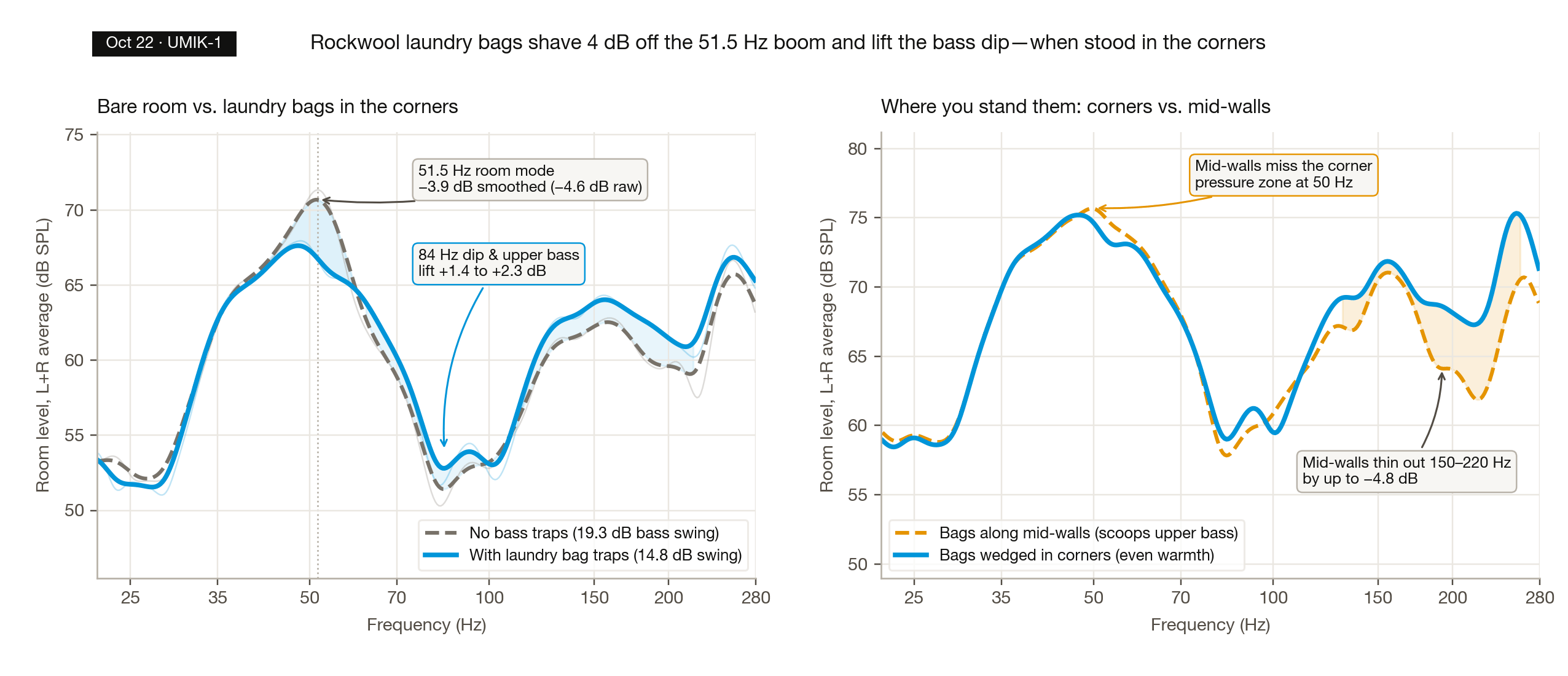
Just as the tape measure predicted, the bare cube’s twin length‑and‑width mode peaked right at 51.5 Hz, followed by a deep cancellation chasm at 84 Hz—a 19.3 dB roller‑coaster across the bass octave.
Standing the laundry bags in the corners changed both the graph and the room:
- The tin‑can boom let go. The 51.5 Hz peak dropped 3.9 dB smoothed (4.6 dB unsmoothed), absorbing almost two‑thirds of the trapped energy at that note and cutting the lingering overhang 120 milliseconds later by 6.5 dB. On “Doin’ It Right,” each 808 hit started and stopped as an actual note with pitch instead of one continuous room‑shaking drone.
- Missing upper‑bass notes came back. Between 84 Hz and 200 Hz, the response lifted by 1.4 to 2.3 dB—something no digital equalizer can do, because boosting into a cancellation null just feeds the wall reflection that caused it. Weakening the corner reflection narrowed the bass swing from 19.3 dB down to 14.8 dB, putting chest and wood back onto upright bass, drums, and voices.
- Corners beat mid‑walls by a mile. When I moved the exact same bags out of the corners to the mid‑walls, the 50 Hz boom crept right back up while 150–220 Hz thinned out by up to 4.8 dB. Corners are where a square room stores its worst pressure; stand them there.
The bags didn’t take me all the way home on their own. That took my friend Jamal bringing over his favorite tube DAC, buying an R‑2R DAC of my own, and building Anchi DAC with a narrow notch for the last few decibels around 51.7 Hz. Still, stuffing laundry bags with stone wool took the tin‑can curse off an 11 × 11 × 8 room before a single line of code ran.
Want a four‑pack of empty bags?
I am looking into small‑batch runs of four 28 × 36 in. heavy cotton bags with red drawstrings and a screenprinted 反 chop—either in Anchi red or matte white on natural canvas—shipped flat so you can stuff them with hardware‑store Rockwool at home, no craft knife required. Write to me and tell me which color you’d pick.
Charles Warren, San Francisco