White paper
The Anchi DAC's sonic characteristics, architecture, and intentional trade-offs
Conventional playback chains ask listeners to choose between digital ringing, ultrasonic harshness, and input overload
Every digital audio playback system has a straightforward job: turn a stream of discrete numbers back into a continuous analog voltage without making audible changes to the character of the music. Depending on the recording and the downstream amplifier, conventional Digital-to-Analog Converters (DACs) usually ask the listener to pick a favorite compromise:
- Either the low cost and convenience of an integrated DAC chip, or crisp transient edges and unclipped peaks. On percussive acoustic recordings and hot modern remasters, hardware brickwall DACs soften transient edges and clip inter-sample peaks because small on-chip Digital Signal Processing (DSP) budgets rely on steep 22.05 kHz Finite Impulse Response (FIR) frequency cliffs just above the roughly 20 kHz upper frequency limit of human hearing. Those cliffs ring before and after sharp drum or plucked-string attacks. With no headroom above full scale, the same chips also clip the reconstructed waveform (+1.5 to +3.3 decibels True Peak, dBTP) whenever consecutive digital samples approach 0 decibels relative to Full Scale (dBFS).
- Either freedom from filter ringing, or top-octave "air" and a clean upper midrange. On wide-bandwidth solid-state and vacuum-tube amplifiers, unfiltered Non-Oversampling (1× NOS) DACs dim top-octave "air" (the open, spacious feeling listeners experience when delicate high-frequency musical sounds are cleanly reproduced) and add upper-midrange harshness because raw stairstep output falls 3.17 dB by 20 kHz while sending −4.8 to −13.8 dBFS ultrasonic mirror images (24.1–68 kHz) to the amplifier. Those ultrasonic images intermodulate inside analog stages and fold audible distortion products back down into the midrange.
- Either the full output level of a modern DAC, or a usable volume range and a safe input level on a vintage amplifier. On classic integrated and tube amplifiers with high input sensitivity, modern 2.0 Volts root-mean-square (Vrms) DAC outputs pin the volume knob near zero and risk input-stage overload because a vintage line stage (such as the 75 mV Naim NAIT 1 used in the author's hi-fi) reaches full output nearly 28.5 dB earlier than a modern preamp. That leaves the volume knob hovering nervously between 7:05 and 7:12: at 7:05 the left loudspeaker has barely woken up, and by 7:12 the neighbors are pounding on the wall to complain to the landlord. Meanwhile, undithered digital volume attenuation crumbles quiet decays into quantized grit.
From its home on the macOS Menu Bar, the Anchi DAC moves reconstruction off fixed silicon and onto 64-bit Apple Silicon
Rather than asking a tiny embedded converter chip to perform heavy floating-point math, the Anchi DAC operates quietly from its home on the macOS Menu Bar, with no milled-from-billet aluminum faceplate, cryogenic cable lifters, or shelf space required. It performs sample-rate reconstruction, harmonic voicing, headroom protection, and dithering in 64-bit floating-point precision (IEEE-754 double) before audio crosses the cable in the direction of someone's ears.
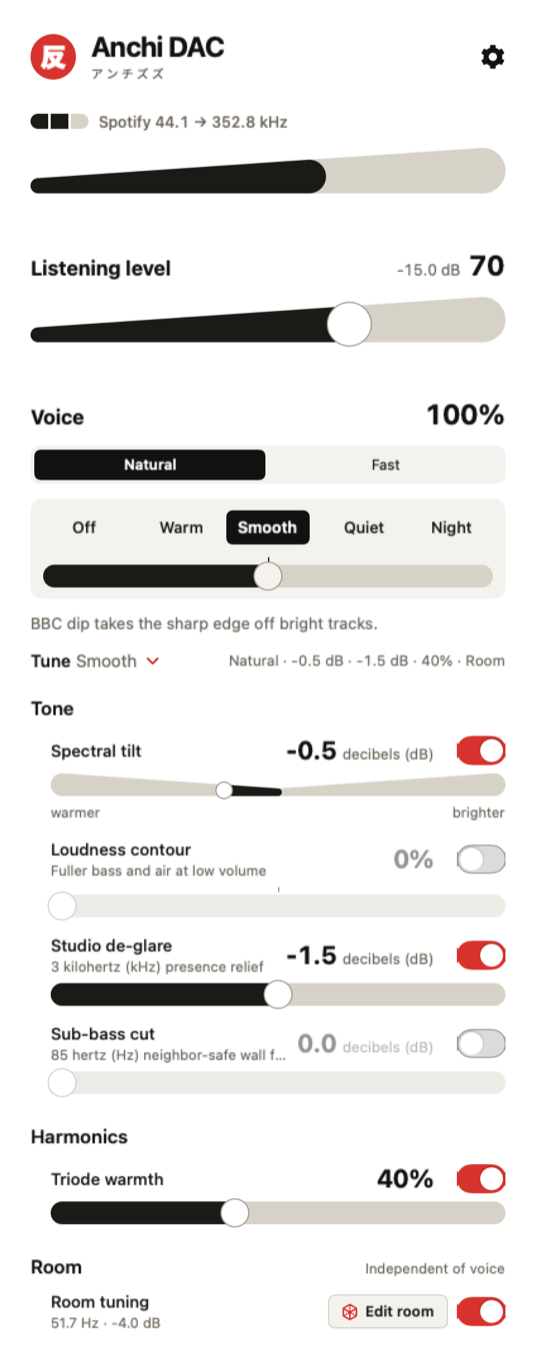
While the Anchi DAC is tuned around feeding a discrete Resistor-to-two-Resistor (R-2R) ladder converter in NOS mode (its own oversampling switched off), fed at 8× (352.8 / 384 kHz) or 16× (705.6 / 768 kHz), it can also feed modern delta-sigma USB DACs (handing them pre-reconstructed 96–768 kHz audio so their first-stage on-chip interpolators do less of the work, or none at the highest rates), tube-output DACs, Single-Ended Triode (SET) and vintage solid-state amplifiers, or a Mac's built-in headphone jack.
A standalone DAC's embedded chip has a fraction of the 64-bit compute headroom of a modern Apple CPU
A traditional hardware DAC chip budgets milliwatts of power and a few hundred fixed-point filter taps for digital reconstruction. An Apple Silicon CPU executes 64-bit Single Instruction, Multiple Data (SIMD) vector math with negligible system load and without waking a cooling fan. Across 26 independent tests aligned with Audio Engineering Society Standard 17 (AES17, measured with 262,144-point Fast Fourier Transforms, FFTs, on November 10, 2026), the Anchi DAC passes 26 / 26 verification gates. Its processing floor sits 23 dB quieter than the physical resistor thermal noise floor of high-precision discrete R-2R hardware, keeping software math well below the analog noise floor of downstream electronics.
1. Frequency response and ultrasonic filtering: avoiding the trade-off between brickwall ringing and NOS treble loss
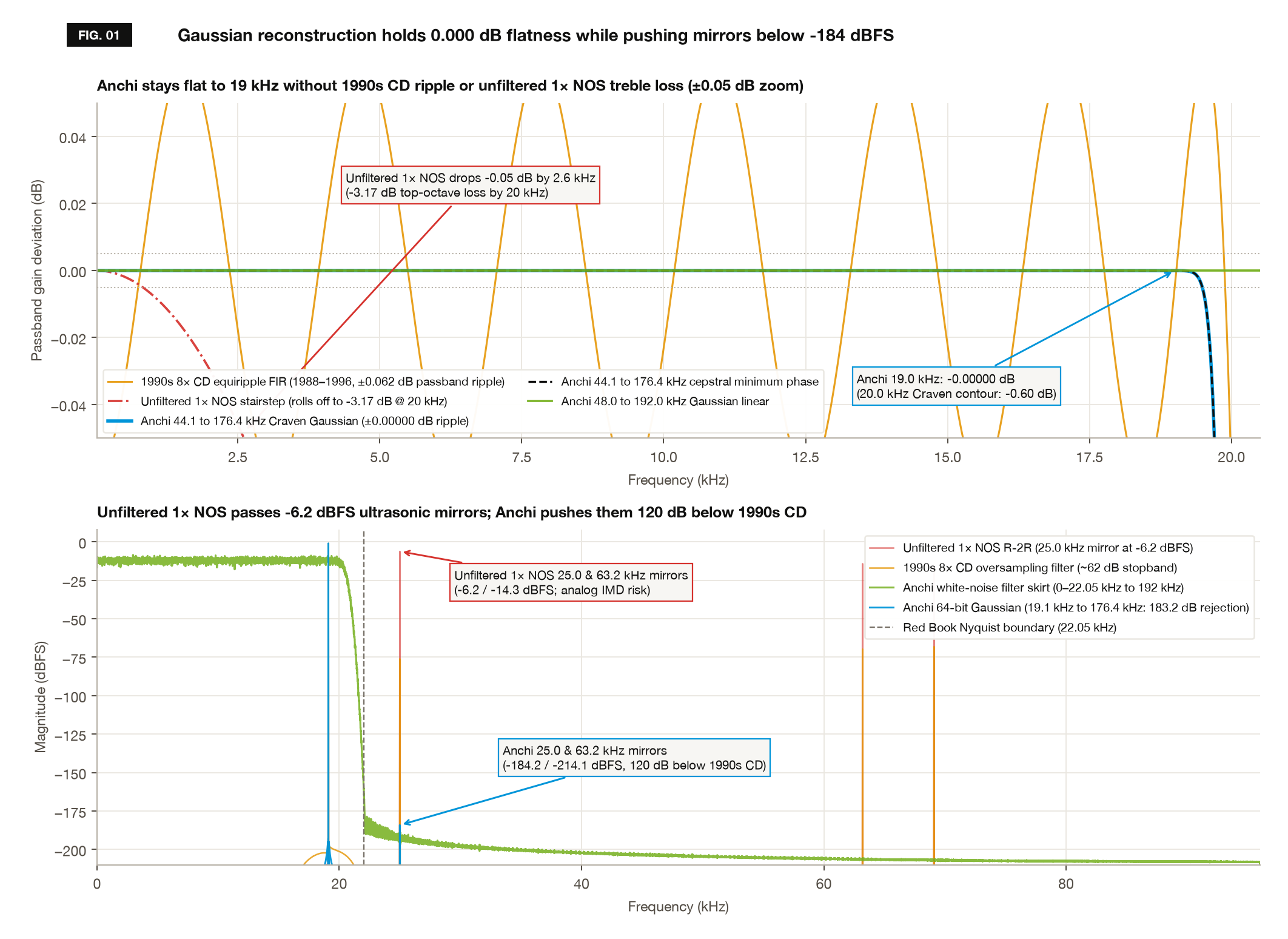
Steep brickwall filters ring in time, while unfiltered NOS stairsteps roll off treble and pass ultrasonic mirrors
By the Heisenberg–Gabor uncertainty principle, a filter cannot act as both a vertical cliff in frequency and an instantaneous wire in time:
- A 1990s 8× CD equiripple FIR (designed with the Parks–McClellan algorithm, as built into low-cost one-chip converters such as the Burr-Brown PCM1710) exhibits periodic passband waves (±0.062 dB in Figure 01's model; ±0.008 dB on the PCM1710 data sheet) and roughly 62 dB of stopband attenuation, leaving residual ultrasonic images above 24 kHz. The best separate filter chips of the decade, such as the Burr-Brown DF1700, did far better: under ±0.00005 dB of ripple and more than 110 dB of attenuation.
- Unfiltered 1× NOS (Zero-Order Hold stairsteps) avoids FIR filter ringing, but rolls off 3.17 dB by 20 kHz due to sample-aperture sin(x)/x droop and leaves the 25.0 kHz ultrasonic mirror of a 19.1 kHz test tone standing at −6.2 dBFS.
Peter Craven's Gaussian-apodizing contour suppresses ultrasonic mirrors by 183 dB without measurable passband ripple
The engine reaches 8× or 16× in two steps. A first stage raises the rate 4× (to 176.4 or 192 kHz), and the triode voicing runs there. A second stage of the same filter then doubles or quadruples the rate again (to 352.8 / 384 kHz or 705.6 / 768 kHz). The Anchi DAC's primary 4× polyphase engine (AnchiFilterBank, evaluated via Apple Accelerate vDSP_dotprD) pairs a pedestal-zeroed Gaussian window (α = 5.35) with Peter Craven's apodizing criterion:
- Negligible passband ripple: Measures within ±0.000004 dB, the worse of the two flatness tests, from 20 Hz to 19.0 kHz (44.1 kHz base) and 20.0 kHz (48 kHz base). Its passthrough null residual sits at the meter's floor of −300.0 dBFS (the reading for an output that matches its input bit for bit), quiet enough not to disturb an electron in the next county, which is unnecessary, though comforting.
- Gentle −0.60 dB @ 20 kHz Craven contour (44.1 kHz Red Book): Reaches −144.8 dB at 22.00 kHz, just under the 22.05 kHz Nyquist limit, attenuating 22.05 kHz brickwall pre-echo baked into legacy studio Analog-to-Digital Converters (ADCs) while halving filter impulse spread.
- >183 dB synchronous and asynchronous mirror rejection: Pushes synchronous ultrasonic mirrors down by 183.2 dB, placing the 25.0 kHz image at −184.2 dBFS. International Telephone Consultative Committee (CCIF) 19+20 kHz twin-tone Intermodulation Distortion (IMD) at 1 kHz measures −234.9 dBFS. For non-integer Sample-Rate Conversion (SRC, such as 44.1 → 96 / 192 kHz), Aleksey Vaneev's 64-bit
r8brain-free-srcrational engine measures 183.4 dB rejection.
Reducing folded midrange intermodulation makes twin-tone probes sound softer at the same volume
"On the 19 kHz + 20 kHz twin-tone IMD probes over the Enyo 15th (NOS), NAIT 1, and Linn Kans, the Anchi DAC sounded noticeably more pleasant and subjectively softer, even though both clips were Root Mean Square (RMS) level-matched. Meanwhile, switching between an 88.2 kHz equiripple brickwall and the Anchi DAC's −0.60 dB @ 20 kHz Craven Gaussian contour on acoustic glockenspiel (EBU SQAM #35) was indistinguishable in top-octave air."
Playing 19 + 20 kHz test tones in the living room is best attempted while dogs and teenagers are out of the house, yet it illustrates a real analog effect. In a band-split spectrum analysis of microphone recordings made at the listening seat, suppressing ultrasonic mirrors lowers the intermodulation that lands in the 300 Hz – 6 kHz ear-sensitivity band by 9.9 dB, which accounts for why the level-matched clean probe sounded softer. The microphone hears the amplifier, the loudspeakers and the room together, so the recording shows the effect, not which part causes it. At the same time, the −0.60 dB @ 20 kHz Gaussian-apodizing contour shortens impulse settling time without sacrificing audible room air on acoustic percussion.
2. 64-bit linearity and intentional 4× harmonic voicing: why notes need to finish ringing
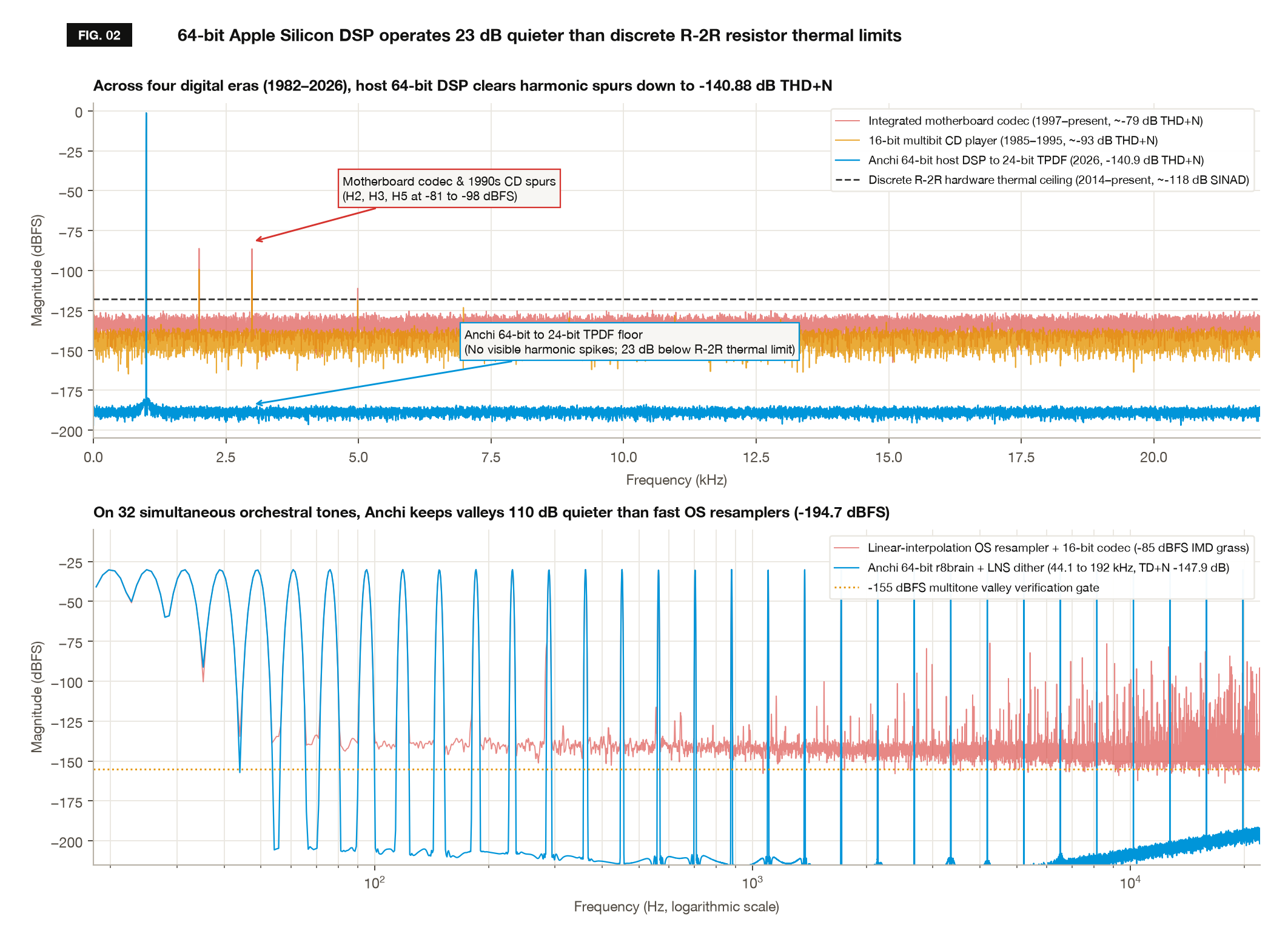
Four eras of digital audio (1982–2026) show how host compute headroom overtook hardware resistor limits
Placing the Anchi DAC's Total Harmonic Distortion plus Noise (THD+N) and 32-tone orchestral multitone measurements alongside prior generations clarifies what each era addressed and what remained constrained:
| Digital era & date range | Representative hardware / trend | Breakthrough over the prior era | Typical linearity & multitone floor |
|---|---|---|---|
| 1. Early brickwall & 16-bit multibit CD (1982–1995) | Sony CDP-101, Philips TDA1541A, Burr-Brown PCM63 + DF1700 8× FIR | Side-stepped tape hiss, wow, flutter, and vinyl wear due to late-night roommate candle-wax spills on my Robert Rauschenberg cover limited-edition copy of Speaking in Tongues; replaced steep analog LC filters with early 4×–8× digital oversampling | ~−93 dB THD+N, bounded by 16-bit quantization and Most Significant Bit (MSB) zero-crossing steps |
| 2. Integrated CMOS motherboard codecs (1997–present) | Intel AC'97 / HD Audio, Realtek ALC897 laptop & desktop codecs | Put 24-bit audio onto low-cost system-board chips everywhere, while sharing noisy digital power rails and fast OS resamplers | ~−79 dB THD+N, with −85 dBFS intermodulation grass when OS linear-interpolation SRC is active |
| 3. Modern discrete R-2R & NOS revival (2014–present) | Soekris, Holo Audio, DENAFRIPS Pontus / Enyo 15th | Matched 0.005%–0.01% surface-mount resistor ladders with 768 kHz USB inputs and direct NOS bypass for external filters | 115 to 120 dB SINAD (Signal-to-Noise-and-Distortion), bounded by resistor matching and Johnson–Nyquist thermal noise |
| 4. 64-bit host-CPU reconstruction (2020s–present) | Signalyst HQPlayer, PGGB, Anchi DAC on 64-bit Apple Silicon | Moves filtering and dithering onto 64-bit host vector CPUs with wider floating-point precision and tap budgets than embedded DAC silicon | −140.88 to −147.26 dB THD+N (178.3+ dB Spurious-Free Dynamic Range, SFDR; −194.7 dBFS multitone valleys) |
Read row 4 with two cautions. Rows 1–3 are measured at an analog output; row 4 is measured in the digital domain, before any converter, so it shows the headroom the math leaves, not what reaches the loudspeaker terminals. And −140.88 dB is not distortion from the engine: it is the noise floor of a 24-bit link with 2-LSB triangular dither (−141.48 dBFS, test 23), read against a −1 dBFS tone. Over a Float32 link, the same engine measures −152.05 dB (test 12).
Odd-order distortion hangs onto decaying harpsichord strings, while 4× oversampled 2nd-harmonic warmth cushions the attack and fades into quiet
It takes a certain commitment to irony to spend months chasing −141 dB of mathematical linearity and then deliberately wire a modeled 1950s 12AU7 glass triode into the middle of it. Audiophiles have spent decades inventing meteorological and culinary adjectives (liquid, grainy, chalky, velvety), mostly to describe what happens during the last half-second of a plucked string. Single-blind harmonic listening tests on studio reference recordings from the European Broadcasting Union Sound Quality Assessment Material (EBU SQAM, Tech 3253 #39 Steinway Grand Piano and #40 Harpsichord) pointed to what those adjectives track:
- Odd-order distortion (H3/H7) and undithered bit-truncation: Sounded on the harpsichord as if the instrument "never got completely done ringing," leaving an artificial wire buzz clinging to decaying strings.
- Clean 64-bit reference (Pure NOS): Fast and silent between notes, though on brightly close-miked harpsichord plucks it felt "very sharp."
- Even-order 2nd-harmonic triode voicing (H2 at −50 dB to −70 dB): "Both felt the easiest to listen to." Because the Anchi DAC evaluates its asymmetric 12AU7 transfer polynomial inside the 4× (176.4 / 192 kHz) oversampled domain, upper-octave harmonics stay below Nyquist rather than folding back down as audible aliasing (<−173 dBFS measured alias floor). Just as important, H₂ scales with the square of signal amplitude (A²). An octave cushion 60 dB below a full-scale plucked attack falls to −120 dBFS, 90 dB below the note itself, once the string decays by 30 dB, allowing notes to finish ringing into the quiet background.
3. Time-domain settling and phase: choosing between "sharp" immediacy and "sanded-off" space
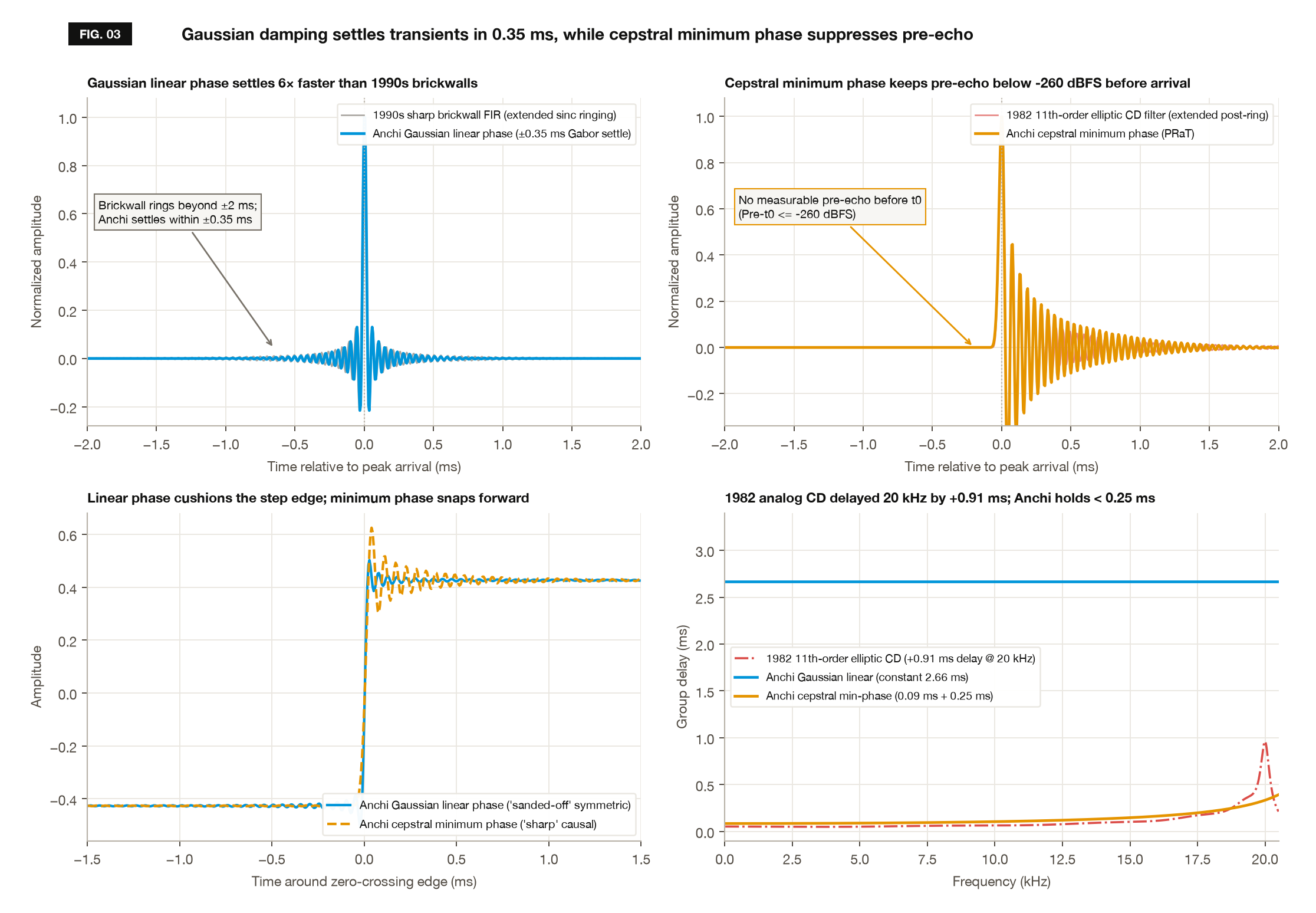
Linear-phase filters spread energy symmetrically around each strike, while early analog filters delayed the treble
Few topics have consumed more late-night forum bandwidth than Linear Phase versus Minimum Phase, a debate often waged with theological certainty over differences lasting three ten-thousandths of a second. In practice, every low-pass reconstruction filter shapes transients in time:
- 1990s sharp brickwall linear FIRs ring symmetrically before and after a drum strike for more than ±2.0 ms.
- 1982 1st-generation CD analog brickwalls (11th-order elliptic analog filters) avoided pre-ringing, but delayed 20 kHz overtones by +0.91 ms relative to the midrange, smearing cymbal arrival behind the snare body.
The Anchi DAC computes both modern Gaussian-apodizing topologies in 64-bit precision (matching magnitude response; the minimum-phase version holds its ideal phase curve within ±0.0004°), switchable live through a 500 ms raised-cosine Voltage-Controlled Amplifier (VCA) crossfade (−136.3 dBFS measured switching artifact floor above 5 kHz):
| Anchi filter mode | Pre-transient behavior | Wavefront arrival | Group delay (20 Hz – 20 kHz) | Audible character |
|---|---|---|---|---|
| Gaussian smooth (Linear phase) | Symmetric Type-II kernel (±0.000000%), compact ±0.35 ms settle | 2.66 ms | ±0.00000 ms constant | Deep hall layering; gently cushioned ("sanded-off") leading edge |
| Minimum phase (Cepstral PRaT) | −260.0 dBFS pre-echo (no measurable pre-ringing before t₀) | 0.09 ms (30× faster) | Bounded 0.249 ms rise (< ⅓ of 1982 elliptic CD) | Immediate transient snap (Pace, Rhythm, and Timing, PRaT); sharper pluck & strike detail |
Suppressing pre-echo concentrates transient energy at the wavefront, unmasking detail on acoustic attacks
"Playing EBU SQAM #27 Castanets, Cepstral Minimum Phase seems to have more information in the sound. Summarized in four words: Sharp vs. sanded-off."
Because linear phase places half of its ringing ahead of the transient, it slightly cushions sharp percussive attacks. Deriving the causal minimum-phase kernel via a 16,384-point real-cepstrum Hilbert transform keeps pre-echo below −260 dBFS and concentrates the filter's transient energy onto the 0.09 ms arrival. That causal alignment mirrors how physical instruments launch acoustic waves in air and unmasks subtle wood, skin, and plectrum detail. The cost: all of the filter's ringing now follows the strike, settling within 3.36 ms, and the top octave arrives up to 0.249 ms late.
4. Dynamic integrity at both extremes: preventing inter-sample clipping above 0 dBFS and distortion below 1 LSB
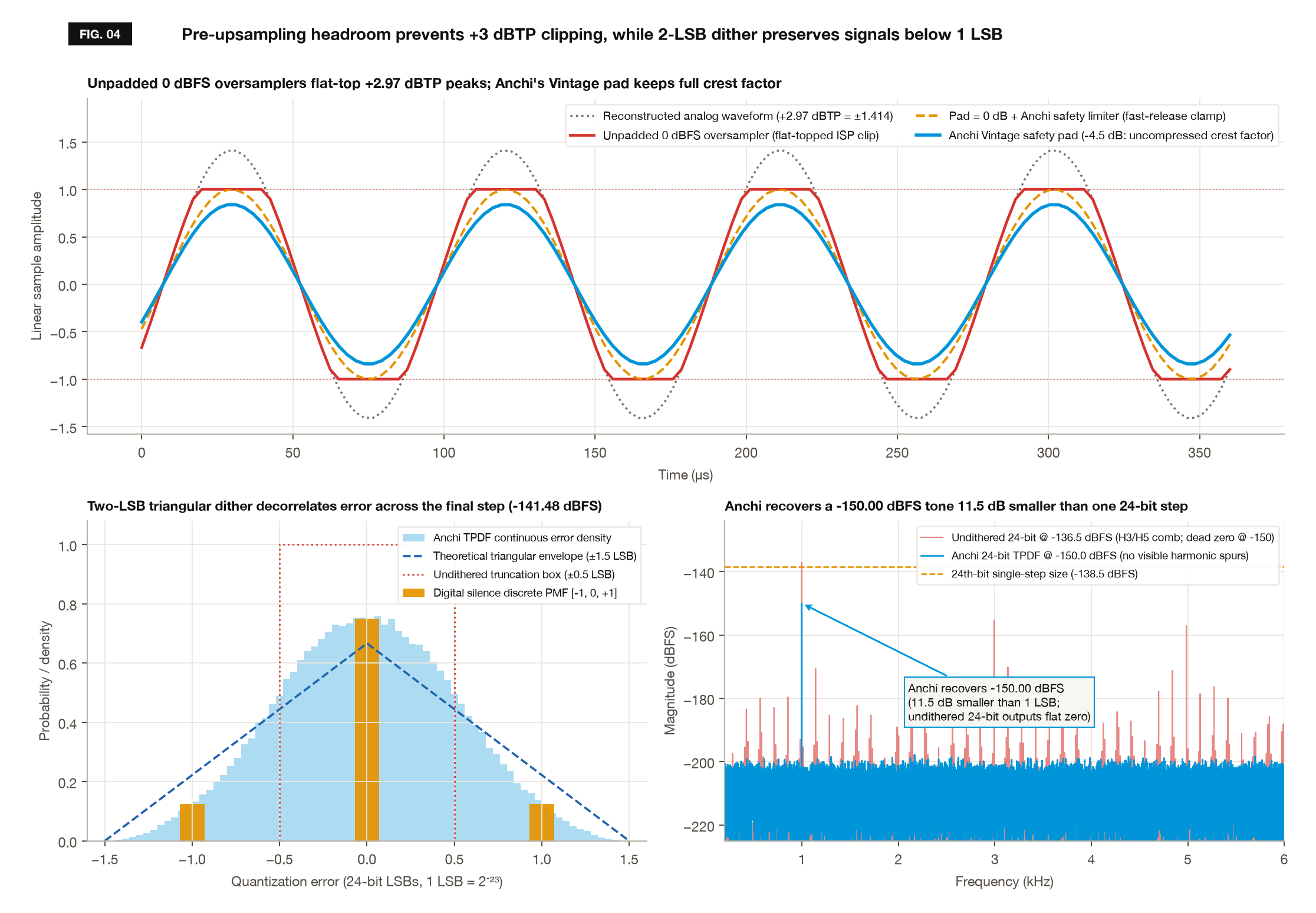
Pre-upsampling voltage presets prevent inter-sample clipping and help protect sensitive 75 mV vintage amplifiers
As Søren H. Nielsen and Thomas Lund first documented on commercial CDs, modern Pulse-Code Modulation (PCM) masters normalized to 0.00 dBFS routinely reconstruct between samples at +2.97 dBTP to +5.11 dBTP (International Telecommunication Union standard ITU-R BS.1770-4).
- In an unpadded 0 dBFS oversampling DAC, those Inter-Sample Peaks (ISPs) flat-top against the digital rail before the analog stage receives them. That clipping compresses vocals and drums even when played back at moderate room volume.
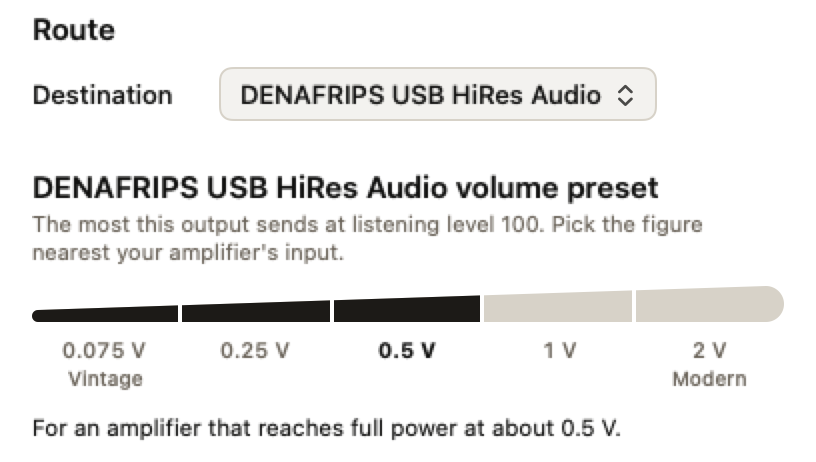
- In the Anchi DAC, five per-Destination voltage presets (Vintage 0.075 V, 0.25 V, 0.5 V, 1 V, and Modern 2 V) apply 64-bit attenuation ahead of final reconstruction, backed by a −6.0 dBFS Vintage Safety Ceiling and a fast-release safety clamp (21.5 ms recovery). At level-matched loudness (EBU SQAM #69 hot-mastered pop test), the Anchi DAC reconstructs +3 dBTP peaks without sample clipping or limiter gain reduction, while significantly reducing the likelihood of overloading a sensitive vintage amplifier across track changes, sample-rate switches, or remote dial turns.
Two-LSB triangular dither rescues as much low-level room detail from distortion as a 24-bit connection allows
Inside the Anchi DAC, filtering, voicing, and listening-level attenuation run in 64-bit floating point. At the USB boundary, however, audio is quantized onto fixed 24-bit integer steps. When a listener turns down digital volume late at night, quiet piano decays cross the final Least Significant Bit (1 LSB) rung of the DAC ladder.
Listening to a dying Steinway chord boosted +70 dB (EBU SQAM #39) is nobody's idea of a relaxing evening, but as an acoustic microscope it reveals single converter steps misbehaving:
- Undithered truncation turns a dying piano string into odd-harmonic buzz (−136.5 dBFS comb spikes) before gating off into digital silence.
- 1-LSB Rectangular Probability Density Function (RPDF) dither removes harmonic buzz, yet its background hiss audibly pumps up and down with the sustain.
- The Anchi DAC's 2-LSB Triangular Probability Density Function (TPDF) and ultrasonic Low-Noise-Shaped (LNS) dither decouple the mean and the variance of the quantization error from the input signal ([0.125, 0.750, 0.125] discrete Probability Mass Function, PMF; ±0.134 dB flat Power Spectral Density, PSD; 0.0216 dB bass-sweep noise modulation). On the bench, the Anchi DAC recovers a −150.00 dBFS sine tone (11.5 dB smaller than a single 24-bit step), rescuing as much low-level room information from turning into distortion as a 24-bit integer link permits.
5. Intentional omissions and known limitations: why the Anchi DAC leaves out dozens of potentially useful tuning options
A useful engineering paper should state plainly what an instrument cannot do and what its design leaves out:
- Dozens of tuning options deliberately omitted: Other playback engines offer thirty reconstruction filters named after obscure windowing polynomials, inviting you to spend Tuesday evening auditioning
apodizing-sinc-ultralight-mk4instead of listening to Bill Evans, alongside 31-band parametric equalizers, DSD64–DSD1024 modulators, headphone crossfeed matrices, and room-convolution browsers. Lacking the self-restraint to own thirty switches without fiddling with them, the Anchi DAC ships with two filters, four musical voicing recipes, and no digital gain boost above 0 dB. Each omitted control represents either a way to overload a 75 mV vintage amplifier by accident or menu friction standing between sitting down and enjoying music. - Real-time buffering latency (about 40 ms) suits listening, not live tracking: Isolating macOS system audio (BlackHole 2ch) from the external USB DAC's crystal clock across a lock-free Single-Producer, Single-Consumer (SPSC) ring buffer plus a 1,024-tap linear-phase FIR introduces roughly 40 ms of pipeline delay (28 ms inside the engine, plus one 12 ms output buffer). The two clocks are never locked: BlackHole runs on the Mac's clock, the DAC on its own crystal, and they drift apart by a few parts per million. The engine measures that drift from the ring buffer's level, read against each device's time stamps, smooths it over tens of seconds, and re-times the already-oversampled audio by the same tiny ratio (asynchronous sample-rate conversion). In steady play the buffer neither empties nor overflows, and no sample is dropped or repeated. Music playback is unaffected, but the Anchi DAC is not suited for live guitar, vocal, or MIDI studio monitoring where sub-3 ms round-trip latency is needed.
- macOS-only, and bounded by downstream analog physics: The Anchi DAC runs on macOS (13.0+) and cannot repeal the thermal noise floor, output impedance, or room acoustics of downstream hardware. Its scope is narrower: keeping the digital reconstruction feeding that hardware quieter than the analog electronics that follow.
- Shaped by the author's hi-fi gear quirks, his taste in music, and his all-too-human ears: While the 26 bench tests in Section 7 are objective and repeatable, every voicing choice in this software reflects one listener's room, a forty-year-old British amplifier and shoebox loudspeaker pair, a preference for lossless digital sources over vinyl, his own taste in music, and a pair of all-too-human ears. Other rooms, amplifiers, and ears will reasonably land elsewhere.
6. Gratitude and citations: the researchers, musicians, and open-source authors behind this work
The Anchi DAC stands on decades of published mathematics, measurement standards, open-access performance, and open-source software craftsmanship. Warm gratitude is owed to:
- Baroness Ingrid Daubechies (born in the coal-mining town of Houthalen, Belgium, and long based at Princeton and Duke University), theoretical physicist, mathematician, and the first woman to lead the International Mathematical Union (2011–2014). Her construction of compactly supported orthogonal wavelets (1988) and Ten Lectures on Wavelets (1992) deepened modern transient and time-frequency analysis across musical signals and visual art alike, leading to her collaborative wavelet brushwork authentication of Van Gogh paintings (2008, distinguishing Van Gogh's spontaneous rhythm from Wacker forgeries and helping reveal hidden overpainted portraits) and X-radiograph canvas-weave dating of Rembrandt and Van Gogh works (2015).
- Dr. Marina Bosi (born near Milan, raised in Florence, Italy, and teaching at Stanford University's Center for Computer Research in Music and Acoustics, CCRMA), a conservatory-trained classical flutist under Severino Gazzelloni who taught flute in Venice before earning her physics doctorate in Florence, collaborating on computer music with Luciano Berio and at IRCAM in Paris, and serving as President of the Audio Engineering Society (AES), helping steward the digital audio coding and AES17 metrology culture this lab relies on.
- Kimiko Ishizaka (born in Bonn and trained in Cologne, Germany), the Japanese-German concert pianist and national-medal competitive Olympic weightlifter who recorded J. S. Bach's Goldberg Variations on a Bösendorfer 290 Imperial in Berlin's Teldex Studio (produced with Robert Douglass) and placed the 96 kHz / 24-bit master into the public domain (CC0), giving independent engineers an uncolored solo piano recording for low-level decay testing, alongside the European Broadcasting Union (EBU Tech 3253 SQAM) recording teams in Geneva.
- Aleksey Vaneev (working from Syktyvkar in the northern Komi Republic, founder of Voxengo and an electronic music producer in his off-hours), author of the MIT-licensed
r8brain-free-src64-bit sample-rate conversion library used on non-integer routes, together with Julien Pommier (the mathematician in Toulouse, France who also created the Pianoteq physical-modeling piano), Hayati Ayguen, and Dario Mambro for the underlyingPFFFTdouble-precision SIMD Fourier engine. - Devin Roth and Existential Audio, authors of BlackHole, the open-source macOS CoreAudio virtual loopback driver that routes system audio cleanly for bedroom musicians, broadcast engineers, and menu-bar apps alike.
- Dr. Peter G. Craven (Oxford mathematician, astrophysicist, and alumnus of the student-run Oxford University Tape Recording Society, where he and Michael Gerzon co-invented the tetrahedral SoundField Ambisonic microphone in the 1970s), whose paper "Antialias Filters and System Transient Response at High Sample Rates" (JAES, 2004) grew out of a lifelong wish to hear classical chamber recordings free of early studio ADC filter ringing.
- Robert A. Wannamaker, Stanley P. Lipshitz, and John Vanderkooy of the University of Waterloo Audio Research Group in Ontario, Canada (physicists who spent weekends recording local classical ensembles and turned 2-LSB TPDF dithering and noise shaping into rigorous theorem in their paper "A Theory of Nonsubtractive Dither," IEEE Transactions on Signal Processing, 2000).
- Søren H. Nielsen and Thomas Lund (working in Risskov near Aarhus, Denmark at TC Electronic, AES Convention Papers 2000 and 2003), who systematically inspected commercial pop and rock CDs to show how +3 dBTP inter-sample peaks clip standard oversamplers, leading to ITU-R BS.1770-4.
- Robert Bristow-Johnson (the Vermont DSP engineer and electric bass player who shared the public-domain Audio EQ Cookbook on the music-dsp mailing list so anyone could build clean biquads), Peter Baxandall (Malvern, England), Peter Walker (founder of Quad Electroacoustics in Huntingdon, Cambridgeshire, an enthusiastic orchestral flautist who voiced loudspeakers against live woodwinds), and Angelo Farina (University of Parma, Italy, 2000, who refined exponential swept-sine transfer metrology inside historic Italian opera houses).
- Finally, Jamal, who brought his Line Magnetic DAC to my house for a listening session, and properly rewired my brain about the role of the DAC in creating a musical experience a few minutes after he cued Idle Moments by Grant Green.
7. The receipts: twenty-six automated AES17 and ITU-R tests validate these measurements from source (measured November 10, 2026)
The measurements in this paper follow published international audio test procedures (AES17-2020 for digital audio dynamic range, notched THD+N, idle-channel noise, and filter response; ITU-R BS.1770-4 for oversampled True-Peak detection; CCIF twin-tone IMD; and Wannamaker et al. (IEEE, 2000) TPDF moment invariance) and were run in the digital domain, on the engine's output samples before any converter, against libNaitDSPBench.dylib on November 10, 2026. Everything needed to reproduce them on an Apple Silicon Mac in one command lives in github.com/chwsfo/anchi-dac-bench:
- Automated 26-point test runner: scripts/audio_loopback_test.py (make test)
- C-ABI benchmark header: Sources/NaitDSPBench/include/NaitDSPBench.h (paired with the signed arm64
libNaitDSPBench.dylibbinary) - Machine-readable 26-point report: reports/loopback/summary_report.json
- Two-Clock Drift Lab (12 checks, 2-hour simulated soak): scripts/loopback_lab/clock_drift.py and reports/loopback/clock_drift_report.json (make test-drift)
| # | Domain | Test metric | Standard / condition | Measured (Nov 10, 2026) | Pass criterion | Verdict |
|---|---|---|---|---|---|---|
| 1 | Real-time | SPSC callback (512f) | 44.1k → 176.4k, Vintage −6 dBFS lock | 0 underruns, −12.02 dBFS | 0 underruns, ≤ −5.99 dBFS | Pass |
| 2 | Real-time | SPSC callback (64f) | 44.1k → 176.4k, tight I/O quantum | 0 underruns, −12.02 dBFS | 0 underruns, ≤ −5.99 dBFS | Pass |
| 3 | Frequency | Passthrough null error | 10 Hz – 0.49 fs Farina log chirp | −300.0 dBFS floor (±0.0000 dB) | < −180.0 dBFS | Pass |
| 4 | Frequency | Passband flatness | AES17 20 Hz – 19k (44.1k) & 20k (48k) | ±0.00000 dB | ≤ ±0.0050 dB | Pass |
| 5 | Frequency | Passband ripple | Gaussian-apodizing linear phase | ±0.000000 dB | < ±0.0010 dB | Pass |
| 6 | Frequency | Craven contour @ 20 kHz | 44.1k → 176.4k (22.00 kHz null) | −0.601 dB (−144.8 dB @ 22k) | −0.60 ± 0.15 dB | Pass |
| 7 | Stopband | Sync image rejection | AES17 19.1 kHz @ −1 dBFS (44.1k → 176.4k) | 183.2 dB (−184.2 dBFS) | ≥ 130.0 dB | Pass |
| 8 | Stopband | Async image rejection | 19.1 kHz @ −1 dBFS (44.1k → 96k/192k) | 183.4 dB (−184.4 dBFS) | ≥ 125.0 dB | Pass |
| 9 | Frequency | Channel balance (L/R) | 20 Hz – 20 kHz stepped sines | ±0.000000 dB | ≤ ±0.0001 dB | Pass |
| 10 | Linearity | 16-bit → 24-bit THD+N | AES17 997 Hz @ −1 dBFS (44.1k → 176.4k) | −94.51 dB (SFDR 129.9 dB) | ≤ −93.0 dB | Pass |
| 11 | Linearity | 24-bit TPDF rate matrix | AES17 10 rate pairs + 41 Hz + 6,997 Hz | −140.88 dB (SFDR 178.3 dB) | ≤ −140.0 dB | Pass |
| 12 | Linearity | Float32 transport |
997 Hz @ −1 dBFS (44.1k → 176.4k) | −152.05 dB (SFDR 179.6 dB) | ≤ −148.0 dB | Pass |
| 13 | Linearity | −60 dBFS low-level gain | AES17 997 Hz @ −60 dBFS (24-bit TPDF) | +0.0000 dB, spurs −183.5 dBFS | ≤ ±0.02 dB | Pass |
| 14 | Linearity | 32-tone multitone | 20 Hz – 20 kHz (44.1k → 192k, LNS) | TD+N −147.95 dB, grass −194.7 | ≤ −136.0 dB | Pass |
| 15 | Time/phase | Impulse pre-ringing | 48k → 192k linear vs. cepstral PRaT | 0.000000% sym / −260.0 dBFS floor | ≤ ±0.01% / ≤ −145 dBFS | Pass |
| 16 | Time/phase | Post-ringing decay | Settling time below −120 dB | 3.36 ms (PRaT) / −400 dB floor (Lin) | < 3.50 ms | Pass |
| 17 | Time/phase | Phase accuracy | 20 Hz – 18 kHz vs. Hilbert target | ±0.00000° (Lin) / ±0.0004° | ≤ ±0.05° / ≤ ±0.50° | Pass |
| 18 | Time/phase | Group delay | Passband ripple & 20 kHz rise | ±0.00000 ms / +0.249 ms | ≤ ±0.005 ms / < 0.80 ms | Pass |
| 19 | Time/phase | Inter-channel phase | 20 Hz – 20 kHz L vs. R | ±0.000000° | ≤ ±0.001° | Pass |
| 20 | Time/phase | Live VCA filter switch | 440 Hz @ −6 dBFS 500 ms crossfade | Click −136.3 dBFS, Δ² = 0 | ≤ −100 dBFS, Δ² = 0 | Pass |
| 21 | Headroom | Vintage safety pad | ITU-R +2.97 dBTP ISP @ −3.5/−6 dB | Err +0.0000 dB, 0 lim hits | ±0.005 dB, 0% compression | Pass |
| 22 | Headroom | Hard safety limiter | +3.01 & +5.8 dBTP (Pad = 0 dB) | 0 clips, 21.5 ms recovery | 0 clips, < 50 ms recovery | Pass |
| 23 | Dither | 24-bit TPDF PMF & floor | AES17 10.0s digital silence | −141.48 dBFS, [0.125,0.75,0.125] | −141.5 ± 0.3 dBFS | Pass |
| 24 | Dither | TPDF spectral whiteness | 20 Hz – fs/2 PSD flatness | ±0.134 dB | ≤ ±0.25 dB | Pass |
| 25 | Dither | Sub-LSB sine recovery | 997 Hz @ −150.0 dBFS (11.5 dB < 1 LSB) | −150.00 dBFS (H3 −214.8 dBFS) | −150.0 ± 0.30 dBFS | Pass |
| 26 | Dither | Noise modulation | 40 Hz sweep (2–20 kHz noise RMS) | 0.0216 dB shift | < 0.05 dB | Pass |
Three readings in this table are the meters' floors, not measurements: −300.0 dBFS (test 3), −260.0 dBFS (test 15) and −400 dB (test 16). In each case the true value is at or below the floor.
I listen through this myself, and hopefully you will too
I built the Anchi DAC because I wanted lossless streaming from my Mac mini to feed the filterless R-2R ladder in a DENAFRIPS Enyo 15th, on to my beloved 75 mV Naim NAIT 1, and out to my ears through a pair of Linn Kan 1 loudspeakers. That amplifier and loudspeaker pair reproduced music for about thirty years after I bought them new in Ann Arbor, Michigan, sat in a box for a few more, and came back into service after a restoration. That I designed and built a 64-bit DSP engine on modern Apple Silicon largely to keep two shoebox loudspeakers from the 1980s happy may qualify as over-engineering, though if you measure audio gear, build open-source tools, or cherish archival hi-fi, your experience and feedback are warmly welcome.
Charles Warren
Founder, Anchizuzu, Inc. · San Francisco, CA
anchizuzu.com